I agree for health issues independent of individual choices. But the difficulty is going to be in fairly determining when it’s somebody’s actions that cause the ailment and when it’s only luck of the draw. If someone is overweight and has a family history of type-2 diabetes, which is it?
I think one of the easier way to lower healthcare costs is to look at end of life costs. Like glitch mentioned above, the costs associated with end of life care in hospital or at home are very different for basically little difference in outcomes. My aunt passed away last year with late Parkinson disease and for the last 2-3 months, she could not recognize anyone or express a coherent thought. But she had to be in medical setting the whole time. Personally, I don’t think I put much value on a few weeks of major suffering or vegetative state at $4k/day. And value decreases further sharply if I’m paying for it instead of society footing my bill.
My understanding is that while genetics may contribute to the risk, obesity is the primary cause, so someone with a family history needs to not be overweight.
I agree about end-of-life care. It’s taboo and it shouldn’t be.
Its not even that. There are some people who rush to the doctor with the slightest sneeze, while others rush to Walmart to get some sudafed. That doctor visit is going to be covered, be it private insurance or Medicaid. But going to the doctor is their choice, often with the premise of “better safe than sorry” because they know they are not paying for it. Society paying for such visits isnt a need, and shouldnt be considered a right regardless of how those people feel about it.
That’s why some form of copays are here to stay. To a different extent, deductibles also have similar impact. But personally being on a HDHP, in years where I unfortunately reached my deductible, it’s true that I wouldn’t thinking as hard whether a doctor visit or PT session was truly needed since I was on the hook for little to no money.
Well it kinda is a right due to the fact that health insurance is still a contract. But I think the main issue is who’s going to draw that line between optional and necessary care. If it was a mild condition, patient is on the hook for the whole bill. If not, insurance pays?
I don’t think that would go well. People would delay doctor visits until conditions are out of control. “I don’t want to be charged $200 if that lump turns out to be nothing or if my doctor determines wrongly that it’s nothing.” In turn catching conditions late would cause higher costs. That’s why preventative visits and vaccines are often free because it saves insurers money over the long run.
Plus as we can clearly see already, private insurers have extreme conflicts of interest in denying claims. If they made the decision of whether a visit was needed or not, that trend we see with prior authorizations would be mirrored in virtually all care.
Which goes back to the part about us needing to just accept health insurance premiums are going to keep escalating no matter what we try to do about it. The only way to materially lower medical costs is to decrease the treatments being paid for.
I dont know about in your neck of the woods, but around here hospitals are constantly closing, shuttering departments, and being restructured. They are in no way flush with cash to absorb lower payments. They may charge exorbitant list prices as leverage, but most pay much lower negotiated rates.
I had an ER visit that produced a $1800 bill. They kept saying insurance denied it, but never actually processed the claim. After they finally did process it through my insurance - a high deductible plan that literally paid nothing, just adjusted for insurance’s negotiated/allowed rates - that bill ended up being just over $500.
And yes, the cost of a bandaid is going to be significantly higher when you are including professional installation costs .
Good background on some of the political noise around Obamacare and the premium extensions, as well as the companies involved in providing the services
as a few Republicans plan to join Democrats to extend the failed Obamacare subsidies rather than reform our own broken health care system.
Socialism is in vogue in America. Various socialists are assuming greater power in the Democratic Party and mayors such as Zohran Mamdani (New York) and Katie Wilson (Seattle) are taking over the leadership of major cities.
The young voters fueling this shift have never experienced life under socialism and have no memories of the meltdowns in prior such systems. As former socialist and communist countries move toward capitalism, many Americans are embracing socialism, according to polls.
The Washington Post editorial board exposed the myth of nationalized systems in its scathing column on the UK’s National Health Service, which is asking sick people to stay away from hospitals as the system struggles to offer basic care.
Yeah I was not surprised by another story about NHS’s failures, but was definitely surprised that the story was in WashPo, and even moreso that it authored by the WashPo editorial board.
This is the problem. Our system isn’t broken, it’s just expensive. The only thing broken is our insistence that bills will disappear if we reshuffle the deck the right way. They won’t.
The only way to curb costs is to curb the the treatments people receive. Instead, we keep insisting that more people be entitled to more (and more expensive) treatments, then wonder why costs keep skyrocketing
Most people who never studied or experienced life under socialism or communism don’t know the difference between them. You should ask your favorite LLMs. The meltdown was of communism, not of socialism. If I’m not mistaken, the best parts of socialism never went away in the former communist states – healthcare and education (at least primary) has remained free, and retirees still receive a monthly check from the government.
While communism is incompatible with democracy and I wouldn’t wish it upon my worst enemy, socialism is compatible, and practically unavoidable. I don’t see you protesting Social Security and Medicare.
The article was about the national health service in the UK, which is far left, but as far as I know, not communist. You claim that the NHS is “the best part of socialism” but the article says the opposite. The WaPo editorial says that the socialized medical system in the UK is falling apart.
Since when are these “free”? We pay very high taxes for them and the taxes do not cover all the expenses, so our government has to borrow in our names. I was not around when Social Security was enacted, but my Republican father was opposed to it. I was a youngster when Medicare was enacted and even then I knew it was a bad idea.
Not correct. We can design a medical system that is more efficient and produces better service for lower cost. In other words, a system based on free market principles. Our current system was designed by the left to be inefficient and collapse under its own weight. Whoever heard of designing a system where neither the customer or the provider know how much a service cost? The left has largely succeeded. According to healthcare finance expert Craig Gottwall, approximately 75% of medical care is paid through the government.
The only reason we borrow is because nobody in charge has the balls to raise the top income tax brackets, and because they all like to spend more than they bring in. Also I was not talking about our government, I was talking about former communist states. Some of them even run a balanced budget and don’t have to borrow.
Also we do not pay “very high” taxes. Half the households pay almost no federal income tax. I also find people who pay nothing or very little in taxes are the ones complaining the loudest about our “very high” taxes.
“Better” healthcare is subjective- people want high quality, fast access, wide provider choice, and low cost. The socialized medicine systems in the UK and Canada provide low cost care at the expense of many of the other desirable aspects. They wait months to see anyone, and years for major life-improving surgeries and some die while on the wait lists.
In the US, where we love our freedom more than conformity and queuing, doctor choice and high quality care are priorities over cost. And we got the system we wanted - an expensive one that offers the best care in the world, including many newer life saving treatments that aren’t covered at all or for until years later abroad, but we get them by paying a high cost.
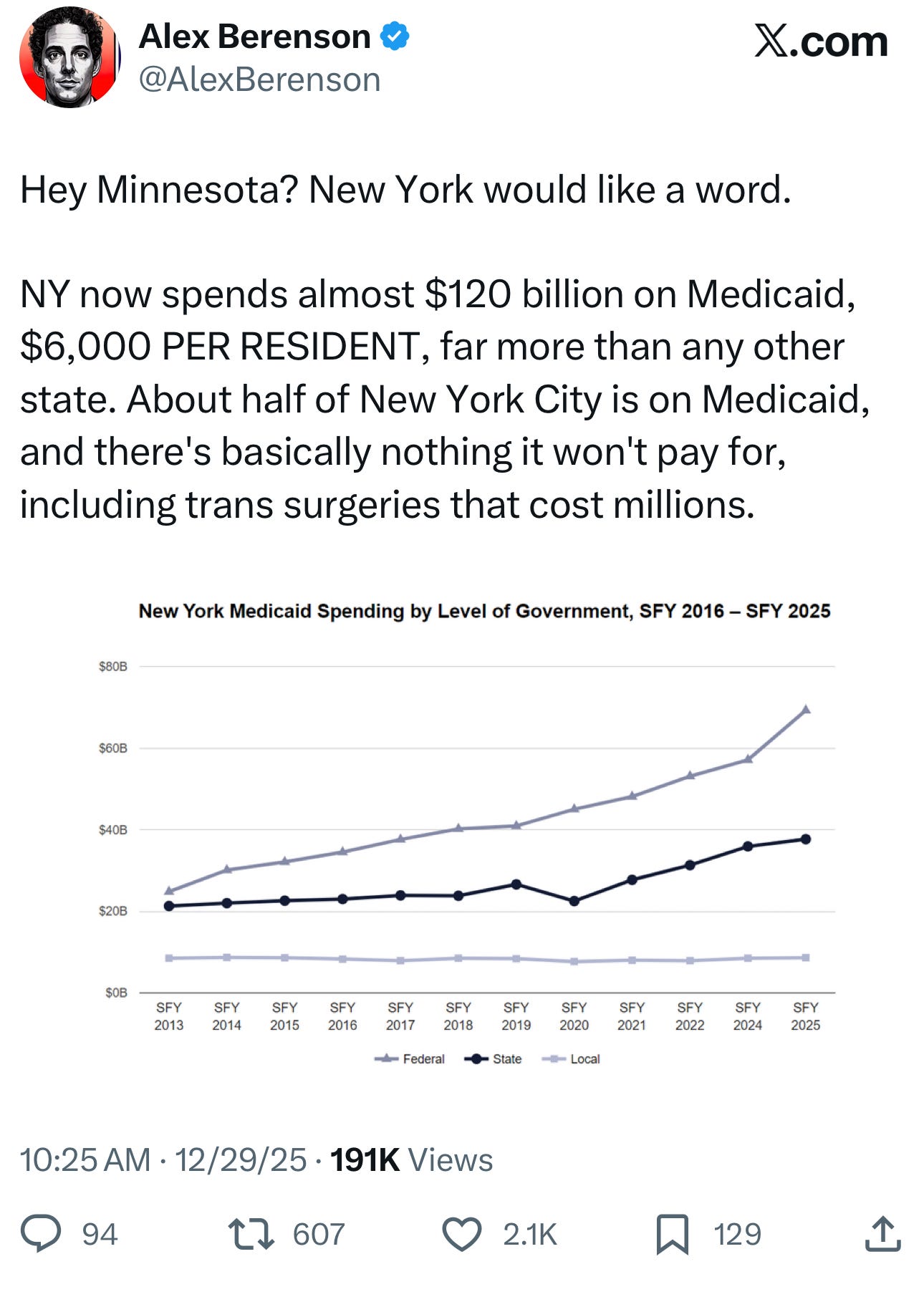
That said, I do think more free market aspects would help rein in some of the runaway healthcare cost inflation. Government spending is notoriously inefficient and subsidies encourage overuse of services while allowing providers to jack up rates on everyone since most are price insensitive “insured” customers. Look at the Medicaid scams and they’ll make the Somalia grifters look like small time punks -
If every state spent at the same level as New York, the United States would spend about $2 trillion on Medicaid alone - yet there is no evidence that patients in New York are healthier or receive better care than those in states that spend far less.
 .
.