We limit it, obviously, and maybe extract it from the air and bury it. Though I’m not a big fan of burying, because I don’t think it’s permanent enough. If only we could turn it back into a liquid or solid state before burying, that’d be better.
I’m phobic about large nuclear in my backyard – the kind that needs to be disclosed in real estate transactions if located within 50 miles. I’m OK with small nuclear, which I believe is exponentially safer. But there are other unsolved problems with nuclear – last I checked there’s still no good way to dispose of the spent fuel. We have to bury it for like 10,000 years. There are problems with wind and solar too, but I believe that solar is at least safer.
I agree waste is a problem. We could reduce the problem by orders of magnitude by reprocessing the spent fuel rods instead of just warehousing them. Done correctly it is safe. France, Russia, India, China, and the United Kingdom already re-process them.
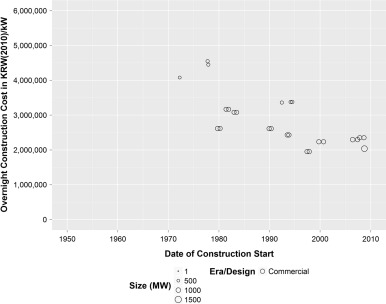
Another problem is cost. I found this article that shows costs in countries that support nuclear power have not increased like they have in the United States.
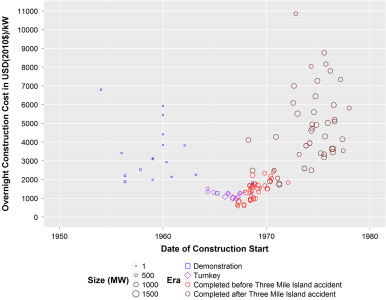
Historical construction costs of global nuclear power reactors
When the US and Western European countries stopped building nuclear power in the 1990s, several other countries continued to build out their nuclear fleets in East and South Asia and Eastern Europe. In particular, large fleets of standardized reactors were built in Japan, South Korea, India, and more recently in China. While a handful of studies note the low cost of reactors in these regions today (Du and Parsons, 2009, IEA, 2010), there is little analysis of historic cost trends in these countries.
Cost in the United States versus construction start date. Notice the rapid increase due to the political activism after 3 mile island.
Makes sense. The cost could have gone up to ensure (via govt regulation or whatever) there’s no skimping going on. The lowest bidder doesn’t always do the best job, and a nuclear accident is a sure way to lead to cost increases.
Not sure if this explains the cost increases of the most recent nuclear project in the US that just went online. IIRC it was supposed to cost 16B but ended up taking twice longer to complete and costing twice more.
Maybe. Maybe they didn’t have any accidents or don’t have as many roadblocks. Maybe people trust their corporations more. Though as far as I know it’s not quite like Japan, where honor is everything and quality is valued, but maybe there’s something similar in Korean culture.
Look at the roadblocks thrown up by the US NRC during the construction of the recently commissioned Vogtle power plant in Georgia
Reuters’investigation of the mess found setbacks from the very beginning, like the use of backfill in Vogtle 3 and 4’s foundation pits that failed to meet regulatory approval causing a six-month delay. Missing paperwork also stalled construction at Vogtle for an additional eight months, it was reported.
That’s one way to look at it. Another way is that what you quoted doesn’t seem like anything was “thrown up”. It sounds like the builder couldn’t follow existing instructions. The regulations are not new, so the builder should have built the foundation the right way. And why are they missing paperwork? The investigation itself points squarely at Westinghouse.
The NRC moves on at its glacial pace towards approving a small modular reactor. It seems to me they are slow walking this.
This article from October 2020 says the design was approved, “but they still have rulemaking”
The US Nuclear Regulatory Commission (NRC) recently announced that it had approved certification of NuScale’s SMR (small modular reactor) design, completing its Phase 6 review of NuScale’s Design Certification Application (DCA). What this means is that SMRs using NuScale’s reactor design can legally be constructed within the US as soon as the rulemaking process completes
It took them until January 2023 to do the “rule-making” I’m not sure whether this is the final final step.
The lowest bidder doesn’t always get the contract, unless they are minority/woman owned. I guess with all the sexual identities available today, it doesn’t make much sense to have just one for women. Set-asides should probably be for everyone except white males and Chinese people of all sexes (or lack of sexes).
Proterra’s corporate board included all of (President Barack Husein Obama’s $80B green energy poster child) Solyndra’s C-suiters + Hunter Biden. With that amount of brainpower, ethics, and big guy support, how could it not fail … after getting all that politicians were willing to give.
Well, when you have no skin in the game, you can let science work. The same will happen, possibly not in my lifetime, when the weather hoax is dumped for the next “meaningful” power grab …
Democrat state officials religiously love solar, wind, and unicorn-produced power. They also hate, devilishly, power that is not produced by the sun, wind, or unicorns. That’s fair, and you can get elected / re-elected on your religious beliefs.
Flyover country is happy to worship their own God, which isn’t a Democrat, Alphabetist, Greener, or other progressive communist. Good on’em. That’s their right …
or maybe not, especially if your “family” is getting remunerated for following a foreign government’s economic plan …
Dalbir Bala, who lives in the Winnipeg area, bought a Ford F150 Lightning EV in January for $115,000, plus tax. He told FOX Business he needed the vehicle for his work, but also wanted something suitable for recreational activities such as driving to his cabin or going fishing. He also wanted an environmentally friendly vehicle as owning one is “responsible citizenship these days.”
But Bala was quickly hit with the reality of owning and operating an EV soon after the purchase. The vehicle compelled him to install two charges – one at work and one at home – for $10,000. To accommodate the charger, he had to upgrade his home’s electric panel for $6,000.
The limitations of the EV truck became even more apparent when Bala embarked on a chaotic 1,400-mile road trip to Chicago.
The California Energy Commission voted Wednesday to extend the life of three gas power plants along the state’s southern coast through 2026, postponing a shutoff deadline previously set for the end of this year. The vote would keep the decades-old facilities — Ormond Beach Generating Station, AES Alamitos and AES Huntington Beach — open so they can run during emergencies.
The state is at a greater risk of blackouts during major events when many Californians simultaneously crank up their air conditioning, such as a blistering heat wave.