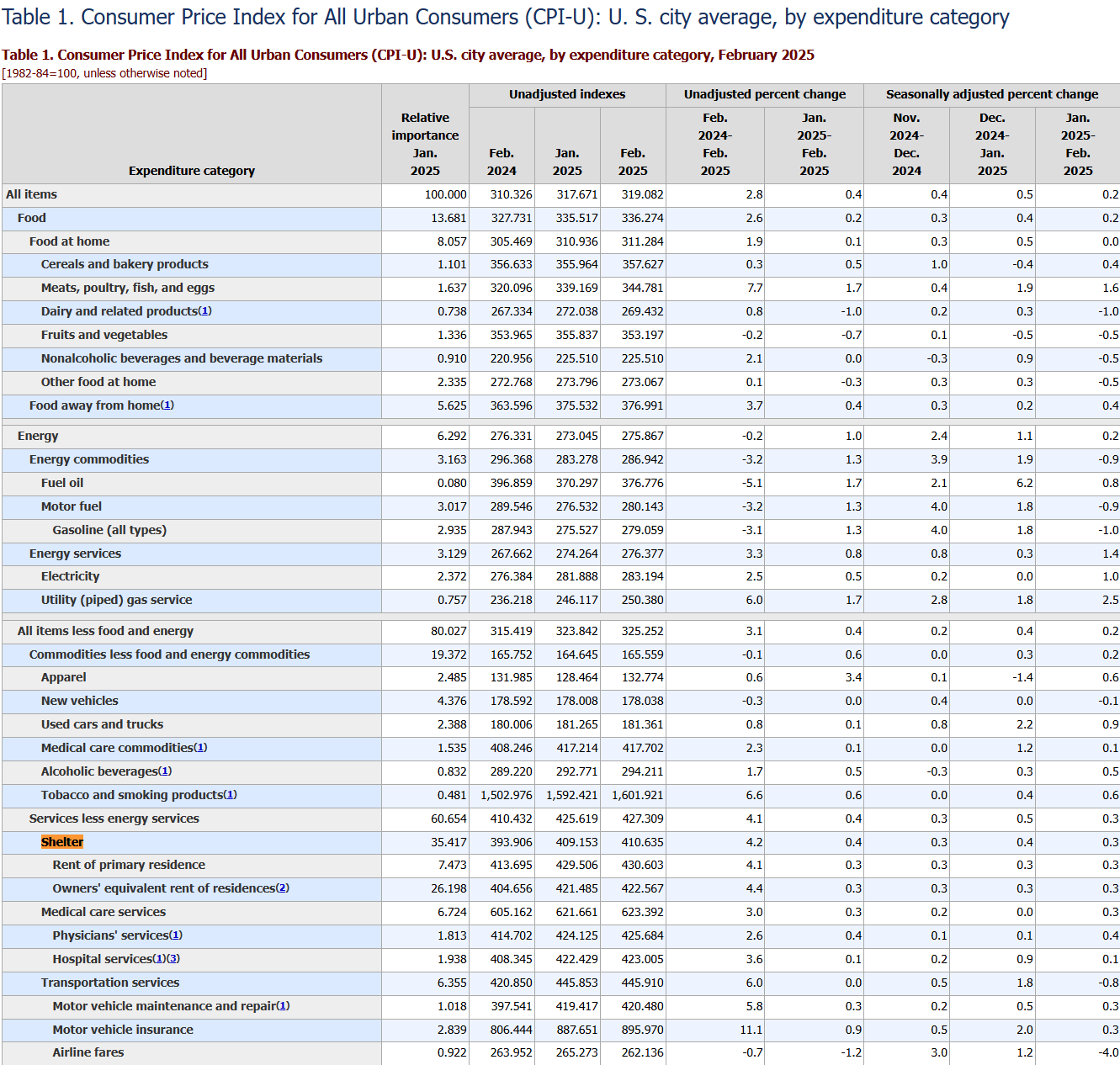
Shelter costs rose 0.3%, making up almost half of the monthly all-items increase. Notable drop in airline fares, down 4%, which likely lines up with the recent weak commentary on air travel. Gasoline prices fell 1%, but the overall energy index still edged up 0.2%
Wholesale egg prices are going down. How soon will it affect your grocery bill?
The U.S. Department of Agriculture reported Friday that the national average wholesale price of eggs has been steadily declining since late February. In other words, the cost that distributors are charging retailers is going down.
According to the latest USDA report, the average wholesale cost of large white eggs was $4.15 per dozen — about half of what it was just a few weeks ago.
Lower demand might help lower cost. So don’t panic-buy your eggs, experts say
It’s no surprise that soaring egg costs have left many Americans looking elsewhere for a source of protein. Ironically, that attitude shift may be helping keep egg prices from rising even further.
“That should happen, because high prices is really the market signal to us consumers to buy fewer eggs. If we buy fewer eggs, that leads to some lower prices,” David Anderson, a livestock economist and professor at Texas A&M University, said in an email.
That’s the reason Wooten from Virginia Tech advises customers against buying eggs in bulk when they’re worried that prices might go up. " Some of what might be driving egg prices is the panic buying that people have been doing over the past couple months," he said.
Edit. Here in Silicon Valley, CA the price of a dozen large eggs at Walmart is $8.12
You’re right, it’s so complicated that even you don’t understand who is being charged. China will impose a 10% tariff, meaning that the Chinese buying from US will pay an additional 10% tax to the Chinese government. And US will impose a 55% tariff, meaning that the Americans and American companies buying from China will pay an additional 55% tax to the US government. This may force the sellers in China to lower their prices, but it likely won’t cover the full 55% and at the end “we” are not “charging China,” “we” are charging ourselves.
A lot of misunderstandings could be saved by replacing the word tariff by the words “(federal) import tax” which people will immediately recognize for what it is (just like sales tax or income tax).
Instead of “the US will have a 55% tariff on Chinese goods” which is vague on who pays what to whom, it’s more obvious to state “importers of Chinese goods to the US will be charged a 55% import tax (paid to the US government)”.
In either case, how much of that import tax will be passed to consumers, how much that’ll impact perceived inflation, is unspecified but the exact % extra cost doesn’t matter to the understanding that tariffs/import tax are a (regressive) consumption tax that you pay your own government when you or the companies you do business with purchase foreign goods.
My point was that we had lower than expected inflation because the actual tariff level during that month was 10% for the most part. Imports from China were muted during that period too, due to the astronomical tariff level for Chinese goods.
If you think about it, it’s sad the average person doesn’t understand what a tariff is.
That definition does not cover fees and taxes charged by other countries on goods and services exported to them. This could include not only charges on imports, but also general taxes such as.VAT or taxes by sub units, such as California’s taxes on hydrocarbon fuels.
Your definition also does not cover non-monetary barriers to trade imposed by countries including the United States.
A mild rise in producer prices echoed the tame CPI earlier this week. What’s clear is that the tariff impulse is not yet in the data. This is not because of a lack of pass-through however. In a study the Fed found that almost a third of manufacturers and nearly half of service firms reported fully passing along tariff-related costs while half of manufacturers and a third of service firms said they passed along some of the increase. A quarter of both types of firms said they absorbed the costs and were not raising prices. As an early indication of this dynamic core goods prices ticked up though only slightly. The trimmed mean gauge ticked up for the first time this year and remains above 3%. Both the change in the trend in goods prices as well as the actual level of inflation suggests that the Fed is not going to be in a hurry to do anything. The labor market has weakened somewhat but not to an extent that is a worry yet. The Fed also said they will be data-dependent given the uncertainty around the external factors driving the economy which means that it will, by design, probably be too late to act whatever happens.
Sounds about right. Manufacturers of high-margin goods may absorb some/most of the cost or switch suppliers to countries with lower tariffs to do so. Some low-margin manufacturers though probably have no choice but to pass the cost through.
As far as timing goes, Dimon responded that it’s likely not gonna show up until late Q3 or early Q4 due to inventory and pause on some tariffs until July. But he was less precise (and more hopeful than knowing) that the impact would be small.
Personally, if I had a large purchase (say an appliance like dishwasher or fridge) that I had put off for a while, I’d consider accelerating it just a tad or wait until tariffs are lifted completely (either by Congress especially after midterms or by the next administration).
 .
.