Oops!! Don’t throw stones when your own folks live in glass houses… or something like that.
2 Likes
Not that Reuters is unbiased here, but it does look better for her that some of the other mortgage related documents appear to indicate it wasn’t a primary home.
The stuff about not claiming a tax deduction for a primary home or how it was reported on her federal disclosures, however, are red herrings. It’s mortgage fraud to lie on your mortgage application (to get you lower, undeserved interest rates), which is independent of the rest of the stuff they describe to try to make her look better.
1 Like
Agreed.
I do believe that mortgage application asks for intent. It should be possible, under reasonable circumstances (like job or family-related relocation, deployment orders, etc) for one to leave their “primary residence” before the year is up, or even a day after obtaining the loan. I think the prosecution would have to prove that the intent was to deceive. Like, she’d have to have listed the property for rent, or retained a leasing agent, or got a signed lease before she signed the loan docs.
And if I’m correct about that, then a “second home” is even more difficult to prove, because she could have intended to live there the last 2 weeks of the year and rented it out even before obtaining the docs, as long as that first lease was for no longer than 180 days. Extending the lease after that if her circumstances changed would also mean that it’s not mortgage fraud, but could be a local tax issue if investment properties were taxes differently than second homes.
This is what really gets me. Why does anyone care, besides her and the lender (and maybe whoever collects property tax)? The peanut gallery has no place in such matters, let alone have the authority to charge, convict and execute.
2 Likes
Good point summarizing the parties potentially harmed in the process. Especially the lender and the property tax authority. But I highly doubt that this surfaced because of complaints from either. If they did, I don’t think they would have taken it to the FHFA or DoJ and instead probably assessed back taxes owed or terminate the loan and/or possibly sue her to get lost interest back.
On the other hand, I actually could see this information being useful back during her confirmation. But I guess at the time, Dems were in control of the DoJ (so dirt was either not found, not searched for, and/or carefully shoved under the rug) and senate GOP may not have had the tools to get that information from the FHFA so that never came to light.
To me, I cannot see it any other way than the administration using the DoJ (and apparently the FHFA too) to find any way outside of her actual job performance to get her fired for cause to replace her. And setting a precedent for every new administration to do the same from now on. 
1 Like
Because some jobs / professions require a certain level of trust, and in order for people to grant them this trust, they must not be liars, or at least not be caught lying. I’m thinking federally-regulated financial professionals, high level security clearances, etc. Same idea extends to mortgage applications, for some reason  .
.
It’s not just that. Material false statements on most credit applications are a crime in and of itself, even if you pay the money back as agreed. A victimless crime, but still a crime.
2 Likes
A 25 basis points cut, with two more cuts later this year:
1 Like
Any chance SCOTUS could make a similar ruling re: Lisa Cook?
Why not? They won’t have to provide any reason either because why bother doing so when overturning 90-yr-old SCOTUS rulings.
RIP independent agencies it seems. At this point, BLS, FTC, FEC, Fed, etc… are just about regular administration employees who will be changing every change of administration and/or whenever they displease POTUS. Of course if SCOTUS, the EAC and the FEC do their jobs properly, we won’t have to worry about future changes of administrations…
Article 2 of the constitution clearly states
Section 1
The executive Power shall be vested in a President of the United States of America.
In particular, previous Congresses and presidents cannot encumber this executive right. There is no such thing as an “independent agency”. The presidency is a singular office and its executive power cannot be shared with other people or commissions.
Edit.
this article discusses the recent decisions by the Supreme Court on the issue of independent agencies. SCOTUS barred a district court from stopping the firing of Rebecca Slaughter I.e. she will be fired and also agreed to hear a case on the validity of a 1935 decision that limited the president‘s power to fire people.
https://www.powerlineblog.com/archives/2025/09/the-supreme-court-steps-up.php
We have been following the cases that address the president’s control over the executive branch under Article II of the Constitution. By statute, Congress has tried to limit the president’s powers, most notably by establishing “independent” agencies that are not fully under the president’s control. The constitutionality of such agencies has always been doubtful, but in Humphrey’s Executor v. United States, 295 U. S. 602 (1935), the Court upheld the law that said the president can remove a commissioner of the Federal Trade Commission only for cause. More recent cases have narrowed the scope of that ruling, and many observers have doubted the ongoing vitality of Humphrey’s Executor.
Now the Supreme Court has taken up that issue directly. Rebecca Slaughter is, or was, an FTC Commissioner whom President Trump discharged. She sued, and the district court in Washington issued an order purporting to bar Trump from carrying out her firing, and keeping Slaughter in place.
Where is that in the Article 2 of the US Constitution? Please point to the specific part ruling out independent agencies created by laws from Congress.
Indeed Congress has made laws establishing government agencies which report to and are accountable to it rather than to POTUS. These agencies have very specific rules defined by law for how they operate. In the case of Humphrey’s Executor v. United States link, the FTC act spelled out that “Any Commissioner may be removed by the President for inefficiency, neglect of duty, or malfeasance in office.” It does not make them truly independent but it also specifies that POTUS does not have absolute authority on commission members.
Same with the Fed Reserve Act which established the Fed. The law specified “each member shall hold office for a term of fourteen years from the expiration of the term of his predecessor, unless sooner removed for cause by the President.”
In my view, either the laws that created these agencies are themselves deemed unconstitutional by SCOTUS, or POTUS should be bound by the letter of the laws as defined by Congress, and not be free to disregard the will and authority of Congress.
1 Like
I quoted the part to you in my post. It’s the very first sentence of article 2. The constitution does not cover every specific case, but gives general guidance.
The powerline blog post that I linked discusses this issue and speculates that SCOTUS will indeed rule that these commissions are unconstitutional.
He’s basically going on the premise that it is the executive branch’s duty to execute whatever Congress passes into law. And only the President can delegate that duty to some independent third party, Congress cannot take that power away.
I think that is the basic claim, that such laws should be unconstitutional. Although I believe the Court does have line item veto power, to strike down specific aspects of a law that is otherwise deemed constitutional.
Things are not turning out as the Democrats hoped
On Thursday, the Bureau of Economic Analysis released its third and final estimate of second-quarter growth, and the results blew through the doomsday chatter from the left. The economy expanded at a robust annualized rate of 3.8% from April through June, far above the 3.3% forecast and higher than the initial estimate of 3.0%.
Consumer spending, long a key barometer of economic strength, also came in hotter than analysts had anticipated. Services in particular saw a strong revision upward, led by transportation, financial services, and insurance. Goods spending wasn’t as strong overall, thanks to a downward revision, but Americans still put plenty of money into motor vehicles and parts. For all the media chatter about consumer pessimism, the numbers show just the opposite: Americans are spending, and they’re spending big.
I think that’s a positive spin on the numbers. Just like Q1 0.6% decrease in GDP was mostly about businesses scrambling to import more to beat the implementation of tariffs rather than the start of a Trump recession.
Inversely, it seems to me like the Q2 numbers are heavily influenced by an abnormally sharp decrease in imports after tariffs took hold. source
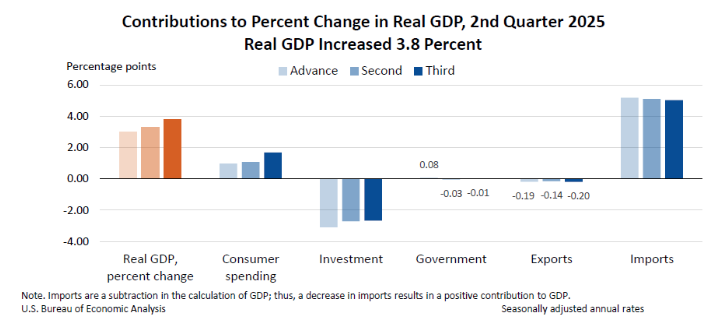
In fact, excluding the large decrease in imports, the increase in customer spending looks fairly unimpressive and not sufficient to make up for a larger decrease in investment.
So I’d be more cautious about the direction of the economy and customer spending. If you looked at the first half of the year, real GDP rose by 1.6%, over 1% less than the 2.7% average real GDP growth over the last 10 years. I think it’ll be more telling in Q3 and Q4 to see how the economy performs vs. the predictions from investors after imports/exports stabilize.
1 Like
You’re welcome to your opinion, but the numbers I quoted are certainly not the cataclysmic values that the Left hoped for. The President has only been in office for eight months and it takes time to undo the damage done by the previous administration.
Stocks picked up steam after the Federal Reserve’s preferred inflation gauge matched expectations.
The personal consumption expenditures price index rose at a 2.7% annual rate. The core PCE, which excludes volatile food and energy prices, rose 2.9% from a year ago. The latter gauge is closely watched by central bank officials. Both figures met economists’ expectations, according to FactSet.
I agree. Especially on Q1 poor GDP numbers which - if again not mostly due to tariffs - should more readily be blamed on Biden’s administration than on the Trump administration that had just taken over.
Also, I’m not sure the Dems care much about the Q1-Q2 2025 GDP numbers. In the post WWII era, recessions have had an average duration of 10-11 months. If I were a Dem, especially those running for Senate in 2026, I’d hope for the GDP numbers to start turning sour around Q3 2025 to Q1 2026 so that the lows of that hypothetical recession would be reached around Q3-Q4 2026 (right before midterms).
ADP September Private sector Jobs Report
Not from the BLS (its Sept jobs report will have to be after the government reopens), but against expectations of +50k jobs growth, the -32k job losses in September could help the Fed keep the rate cuts coming, especially if October numbers do not improve (or are not available from BLS).
2 Likes