I don’t recall ever having to visit WhiteHouse.gov for any “announcements” or “facts” before this year.
The week began with faint optimism that October’s data would confirm a soft landing. Instead, it delivered another reminder that inflation is sticky and the labor market is cracking. Private indicators showed the largest monthly layoff total in over 15 years, led by Amazon and Target. ADP’s +42k headline gain did little to change the story. Official reports remained frozen as the government shutdown stretched past forty days, leaving investors to piece together an incomplete picture that looked increasingly fragile.
The macro data slate stays thin. Tuesday’s NFIB Small Business Optimism Index is expected around 98.2, down from 98.8, reflecting growing unease among small firms about tariffs and financing costs. Inflation pressures remain, while hiring and expansion plans soften. Combined with October’s private payroll stagnation and record layoffs, the backdrop points to a labor market losing traction but not yet breaking.
1 Like
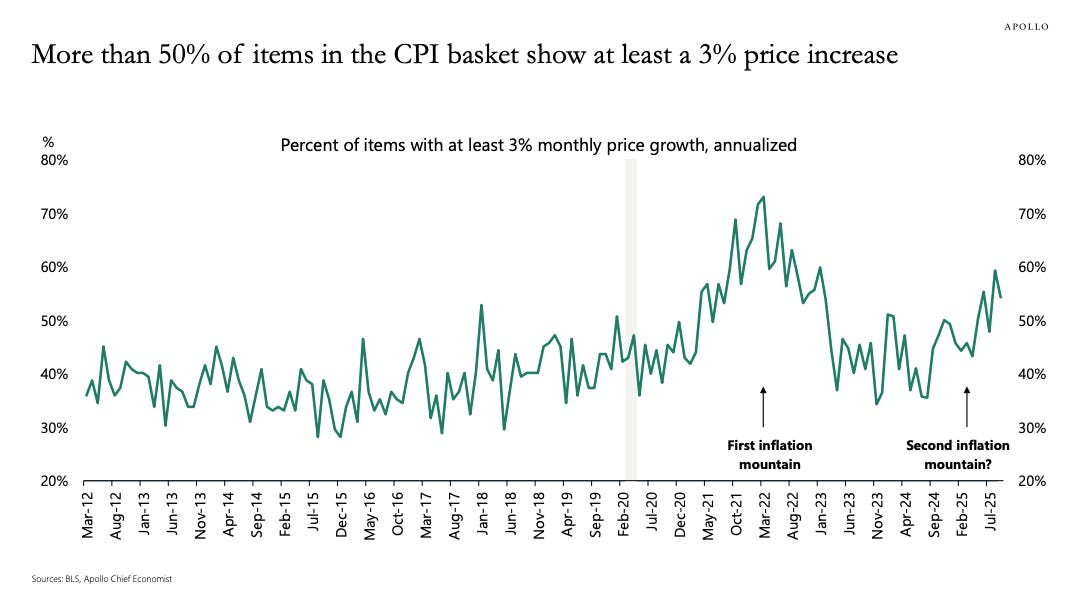
Meanwhile consumer sentiment is really bad
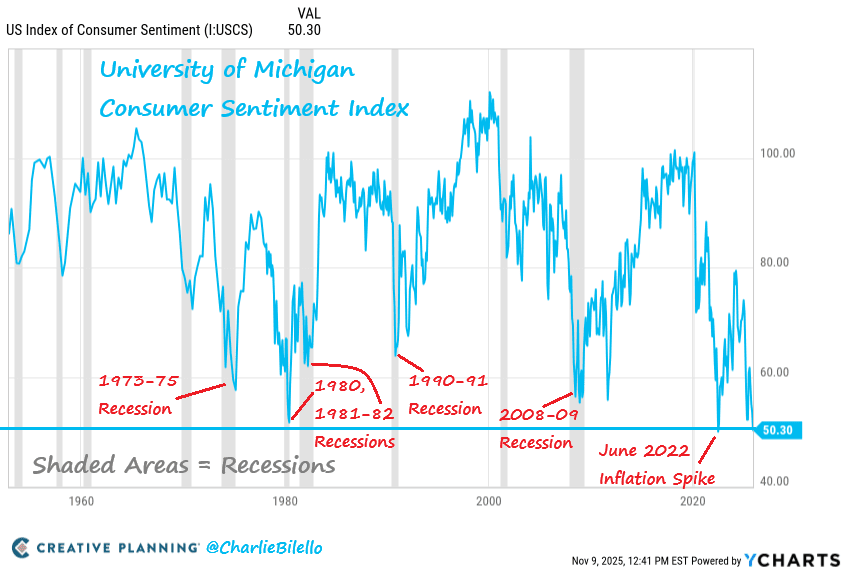
which is at odds with corporate earnings (doing well), but the layoffs have been pretty significant lately esp in Big Tech.
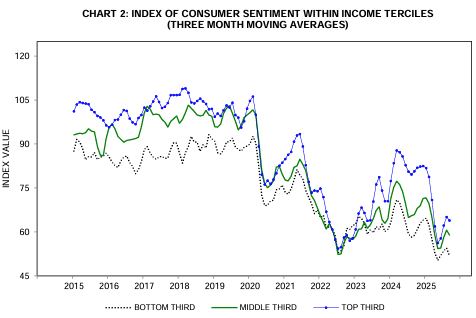
troubling signs for lower- to middle-income Americans already experiencing recession-like conditions through struggles with daily expenses. Consumer sentiment among the lowest third of households by income sits below levels seen during the 2008 to 2010 financial crisis, while the next third mirrors those conditions, and overall sentiment remains sharply down from pre-pandemic levels.
1 Like
Things definitely do not appear more affordable than a year ago for most people (and potentially about to get worse for some with lower ACA subsidies).
In addition, with sluggish job market (downward pressure on wages), the outlook for wages to outpace inflation in the coming months is rather dim for most people. Combined with inflation >3%, not too surprising that sentiment would be pretty low.
What’s interesting also is that for all the talk about bifurcating economy (high incomes vs low-income) sentiment is pretty uniform across income tiers:
Not directly related to inflation but potentially important:
Here in Silicon Valley California it is about $4.50 per gallon.
Fed cuts another 25 basis points. Sees more cuts in the future:
1 Like
Not sure about the slower pace ahead. Extra cuts seem likely and possibly soon considering the latest jobs report which bumped unemployment rate to 4.6%. All jobs numbers for August and September were also revised down so an even bleaker job market than previously thought. So I’d think the jobs part of the Feds mandate looks to become the dominant concern if it’s not already.
Also annual wage growth was down to 3.5%, lowest in 4 years, and barely keeping up with inflation, so not too many hints of labor costs pressure on inflation in the near future.
Update: annual inflation rate dropping to 2.7% in November probably strengthens the case for further rate cuts sooner rather than later.
1 Like
https://caes.ucdavis.edu/news/california-gas-prices-set-soar-2026
California Gas Prices Set to Soar in 2026
Two refinery closures will leave Californians with less gas and higher prices.
Retail gasoline prices in California have been consistently higher than the U.S. average, but the gap may continue to grow with the upcoming closure of two gasoline refineries. A new article by University of California, Davis, economists examines the impact of these closures on California gas prices. The authors find that, by August 2026, when the full effect of the closures is realized, California prices could rise by $1.21 if no further significant changes happen in the market.
Phillips 66 announced it would be shutting down its Wilmington refinery in the fourth quarter of 2025 and Valero, announced it would also be closing its Benicia facility in April 2026. These two facilities account for 8.3% and 8.6% of the total refining capacity in the state, respectively. What will a 17% decrease in refining capacity look like for California consumers?
To be compliant with California’s stringent air quality and other environmental regulations, California gasoline must be blended with specific components not required elsewhere in the United States. As a result, most of the gasoline used in California is produced in-state. When major California refineries shut down, this supply cannot be easily replaced with out-of-state supply and Californians are more likely to feel the results at the pump.
2 Likes
Meantime, California’s solution is that the beatings will continue until morale improves.Here’s the state government propaganda piece. Apparently they think that higher gas prices are due to oil industry malfeasance so their solution is to require more reporting and justification for price increases. The oil industry response is to close refineries and leave the state.
-
The Governor signed legislation last month that provides a path for a targeted, locally-led, environmentally responsible and safe increase in oil production in Kern County to boost overall fuel supplies in the state.
-
Following record gasoline price spikes in 2022, Governor Newsom called for a special session and worked in partnership with the legislature on first-of-its-kind transparency requirements on the oil industry, which have already helped the state manage fuel supply and stabilize prices.
-
Moreover, the transparency afforded by that first special session legislation led to the second special session legislation focused on building more stability into California’s fuel supply, including by the establishment of a minimum supply inventory and requiring plans for refinery resupply during maintenance, work that is now underway by the CEC.
-
Both pieces of special session legislation gave the state new tools to understand and help manage the state’s petroleum market – providing more transparency than ever before to allow the state to make informed decisions with respect to our transition away from fossil fuels and towards cleaner, alternative fuels.
2 Likes
Wont that mean lower gas prices for everyone else, since 17% less refining capacity means less demand for oil on the open market, meaning other states have less competition for the oil they refine?
Just a random thought - since California requires this expensive gas, is it illegal to cross state lines to fill up, and return to CA with a tank of noncompliant gas?
I doubt it’s illegal. It’d be too cumbersome to require all cars to exchange their gasoline with CA-compliant gas at the border. I wouldn’t be surprised if it is illegal to bring in a few canisters though.
I’m sure the people who live close enough to a state line and care about a few bucks fill up on the other side. There are gas stations right past the state borders in AZ and NV (and probably OR), though they too are already priced higher, so ideally you fill up further away. Problem is most Californians live closer to the coast and too far away from the state line for this to make financial sense.
2 Likes
That’s what I would think. But then I think about deisel fuel and heating oil, and it isnt too far out of the realm of possibilities. Even if it is more a technicality and they arent actively pursuing enforcement.

More good news on inflation. Could be due to deporting hundreds of thousands of illegal aliens?
Well, the article is about rents, not about inflation. This won’t be reflected in inflation for about a year. And sure, it is possible, even likely that rents are falling due to reduced demand, and certainly mass deportations would play a role in reducing demand. Though I don’t know if deportations and rent reductions occurred in the same locations. This would require additional research. The steepest decreases were in:
- Austin–Round Rock–San Marcos, Texas: −6.6%
- Denver–Aurora–Centennial, Colorado: −4.8%
- Birmingham, Alabama: −4.6%
- Jacksonville, Florida: −4.2%
I don’t recall mass deportations (or much ICE activity reported) in Austin, Birmingham, or Jacksonville.
It could also be because of what is in the article:
This only mentions 2024, but IIRC there was a lot of new permit applications during the pandemic and construction picked up soon after that.
BTW did they really deport hundreds of thousands? Is anyone keeping track?
Second, this month, the Department of Homeland Security announced the departure of more than 2.5 million migrants who were in the country illegally. “Since January 20, 2025, DHS enforcement operations have resulted in more than 605,000 deportations,” the department said in a statement. “DHS has prioritized removing the worst of the worst criminal illegal aliens as part of the Trump administration’s efforts to return law and order to the United States. Additionally, thanks to the comprehensive efforts of DHS law enforcement, 1.9 million illegal aliens have voluntarily self-deported since January 2025.”
My estimate was way under. This many people will certainly have an effect on the demand for rental housing nationwide.
LOL,
If a tree falls in a forest and no one is around to hear it, does it make a sound?"
Austin built a massive amount of housing in the last few years
Yes, but it is about 6.7 million miles away
