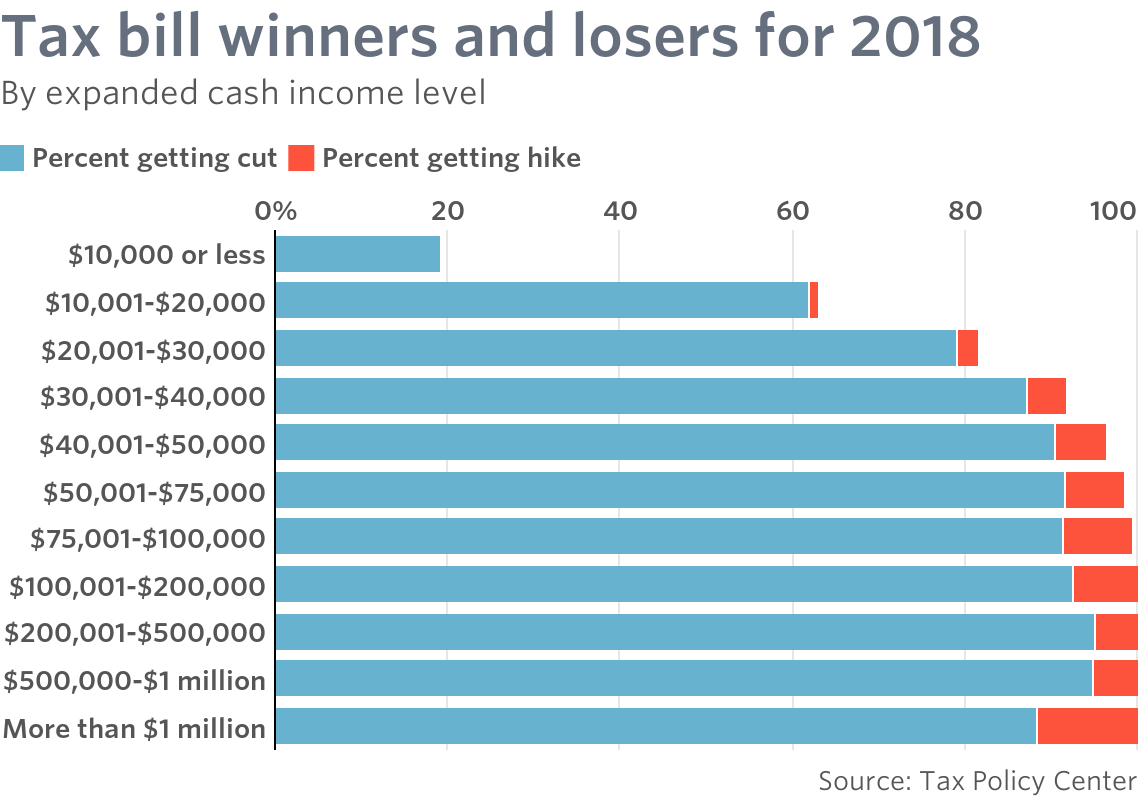
Summary of impacts of the new law by income level. Almost everyone will see the same or more often lower taxes for 2018.
The good news is that there aren’t many who will pay higher taxes next year — about 8.5 million, compared to the some 143 million who will get lower taxes.
The good news is that there aren’t many who will pay higher taxes next year — about 8.5 million…[/quote]
Eight and a half million ain’t chump change, and that number doesn’t include the tens of millions impacted by healthcare expenditures.
Turns out the tax cuts for the middle-class are a lot smaller than the tax cuts passed by the Dem congress and signed by Obama as part of the stimulus legislation. And after they went into effect, a large minority who received the tax cut claimed they didn’t (Republicans), another large minority stated they received the tax cut, and a small minority acknowledged they got the tax cut but said it was too small to notice.
So they want to run on that for the mid-terms while throwing gargantuan amounts of money at the already rich & corporate, even though income inequality in the U.S. is already greater than in any other democracy in the developed world ?
To be fair to you, I read SpeedingLunatic’s post and honestly thought - WTH do windows have to do with this, and how could one not know how to operate a window
As an aside, I’ve found your contributions to this thread to be more helpful than many others’ “contributions”
Not sure whether this is a targetted attack, or just an easy way to generate more revenue, but gambling has become much more problematic under the new bill.
First - they explicitly got rid of the ability to count comps in wagering income for the purposes of the limitation on wagering losses (overruling a tax court decision)
Second - the increase in the standard deduction increases the cost of claiming gambling losses because of the doubling of the standard deduction and removal of other itemized deductions.
I find the first to likely be an intentional attack on gambling because it doesn’t raise that much revenue, and is a weird item to just pop into the mind of the writers. The second is most likely just an unintended effect of making other changes. However, just pointing out that if you itemize gambling losses and wouldn’t otherwise itemize, you may want to look carefully at your activities in the next year.
For all those that aren’t aware - you cannot net out gambling gains and losses. You have to record each “session” separately. For example, if you win $500 in blackjack session 1, then lose $300 in blackjack session 2, you report $500 in “other income” and report $300 as an itemized deduction. If you don’t itemize as a result of the doubled standard deduction, it means you’re paying tax on $500, when you really only earned $200.
[quote=“gwraigty, post:730, topic:1661, full:true”]
Didn’t mean to make myself a laughing stock or to take this so far off topic [/quote]
Please.
Why would you be a laughing stock for having an aversion to proprietary software ? I’m right there with ya, I avoid it as much as I can.
And it’s not just software. Look at Apple with the batteries. If they had just added a battery door from the getgo, they wouldn’t be facing a large class action lawsuit now.
Darn, my county doesn’t allow for paying 2018 property tax in 2017, something about a state law. I guess they get so much inquiry that they posted that on their home page.
Let’s be fair here, how many people put in their wagering gains other than those which receive a W2G?
Other than professionals, for which good recordkeeping would be essential like any other business, I doubt many do.
Over 1m claimed gambling winnings, just under 900k claimed losses. Not sure how many of those received W-2Gs. Most professionals have non-professional gambling activities as well. Even though the change to itemizing doesn’t specifically affect professional gambling, the statutory change purports to apply to professional gambling.
Gambling appears to be surging though - with the fantasy football sites and the Supreme Court case re New Jersey.
That makes no sense. You can customize the default application for each file extension somewhere in Control Panel (probably Settings → Control Panel → Default Programs). Google it.
It’s only 13 months if you paid the payment due 1/1/2017 in 2017 and not in 2016. This is explicitly allowed, because the payment due 1/1/2018 contains interest accrued in 2017, so you can make the payment in 2017 and deduct the interest in 2017 taxes.
You can pre-pay the entire year’s interest and have the servicer apply these payments as interest, but you cannot deduct that interest on your taxes before it accrued. Not because it has not been billed, but because it had not accrued, and the rules explicitly forbid the deduction of unaccrued interest.