Why lower rates if economy is fine (say like now with low unemployment, decent GDP) and inflation is in the correct range (pretty close to what we’ve got the last 6 months)? You only risk feeding the economy with too much cash leading to inflation spike like we just had.
Does the Fed have any mandate beside keeping a low inflation (about 2%) and near full employment? Any specific mandate or target range for interest rates?
The way I’m seeing it, if they feel the need to cut rates, it means either inflation is getting too low or unemployment is spiking up (or both). Neither of these things are signals of a great economy usually, no?
I finally managed to do just that too and thinking along the same lines. I don’t see the Fed raising interest rates soon considering the economic data coming in recently and the usual inertia of rate hikes/cuts (last rate increase was less than 6 months ago).
Inflation getting too low (below ~2%) is not a signal of a bad economy, it’s a signal that the economy could become bad in the near future. You have to remember that there’s a delay between interest rate setting and inflation, so they’re trying to predict the future and guide it toward the desired outcome.
From the article The case for high yield bonds remains very strong
The U.S. high yield bond market experienced a robust rally at the end of 2023, returning 9.2% from mid-October through year-end, due to declining Treasury yields, reduced recession fears, large retail fund inflows, and limited new issuance.13 However, the asset class remains attractive on a relative basis due to several important factors.
High expected return: The average yield-to-maturity in the asset class is near 8.0% – which is well above the ten-year average – and compelling compared to the roughly 5.0% offered in the investment grade bond market.14
High quality: Around half of the asset class is rated BB (the credit rating tier just below investment grade) and only 11% is rated CCC (the lowest tier), compared to 45% and 17%, respectively, a decade ago.15 For context, only one-quarter of the U.S. leveraged loan market is currently rated BB.16 This quality advantage partly reflects the increase in the average size of high yield bond issuers in the last decade, as smaller borrowers have increasingly migrated to the leveraged loan and private credit markets. Additionally, leverage ratios in the asset class are fairly healthy compared to the pre-pandemic and long-term averages. (See PCQ 3Q2023 for more details.)
High average convexity: U.S. high yield bonds still trade at an average price of 92 cents on the dollar, and their average duration is 3.3 years, roughly half the average duration of investment grade bonds.17 Thus, high yield bonds should benefit meaningfully from the pull to par in the coming years as bonds mature. Additionally, all fixed rate assets, including high yield bonds, should be better positioned than they were in recent years now that the likelihood of near-term interest rate increases has fallen sharply.
Demand for Treasury bonds has been particularly low. “Tails” (Wall Street lingo for higher-than-expected bond yields because of weak demand for Treasury securities by primary purchases) have been unusually long by historical standards at auctions, especially in the 30-year securities market. Meanwhile, the Federal Reserve last month reported a record annual loss, a loss that stems largely from the Fed’s mass purchase of Treasury bonds, which depreciated when interest rates were hiked to tame surging inflation.
This weakening demand for debt is occurring while the supply of debt is rapidly increasing. Some $10 trillion must be sold in 2024 to cover deficits and maturing securities. That is more than a third of U.S. gross domestic product. Meanwhile, the U.S. is projected to add another $20 trillion in new debt over the next decade.
Whether the market will absorb this amount of debt is unclear. The nation’s debt-to-GDP ratio is projected to be 130% in 2025. That is substantially higher than Greece’s debt-to-GDP level in 2010, and Mitchell and Rubin say time is running out to correct the course.
Too bad Shinobi isn’t around. The bond market is really having issues right now - either someone big like China is dumping their holdings of treasuries or some basis trade is blowing up.
Stocks maybe doing poorly, but the bond market is much bigger and a bigger threat to the government and the economy than whether your 401k is worth ±10% of what is was recently.
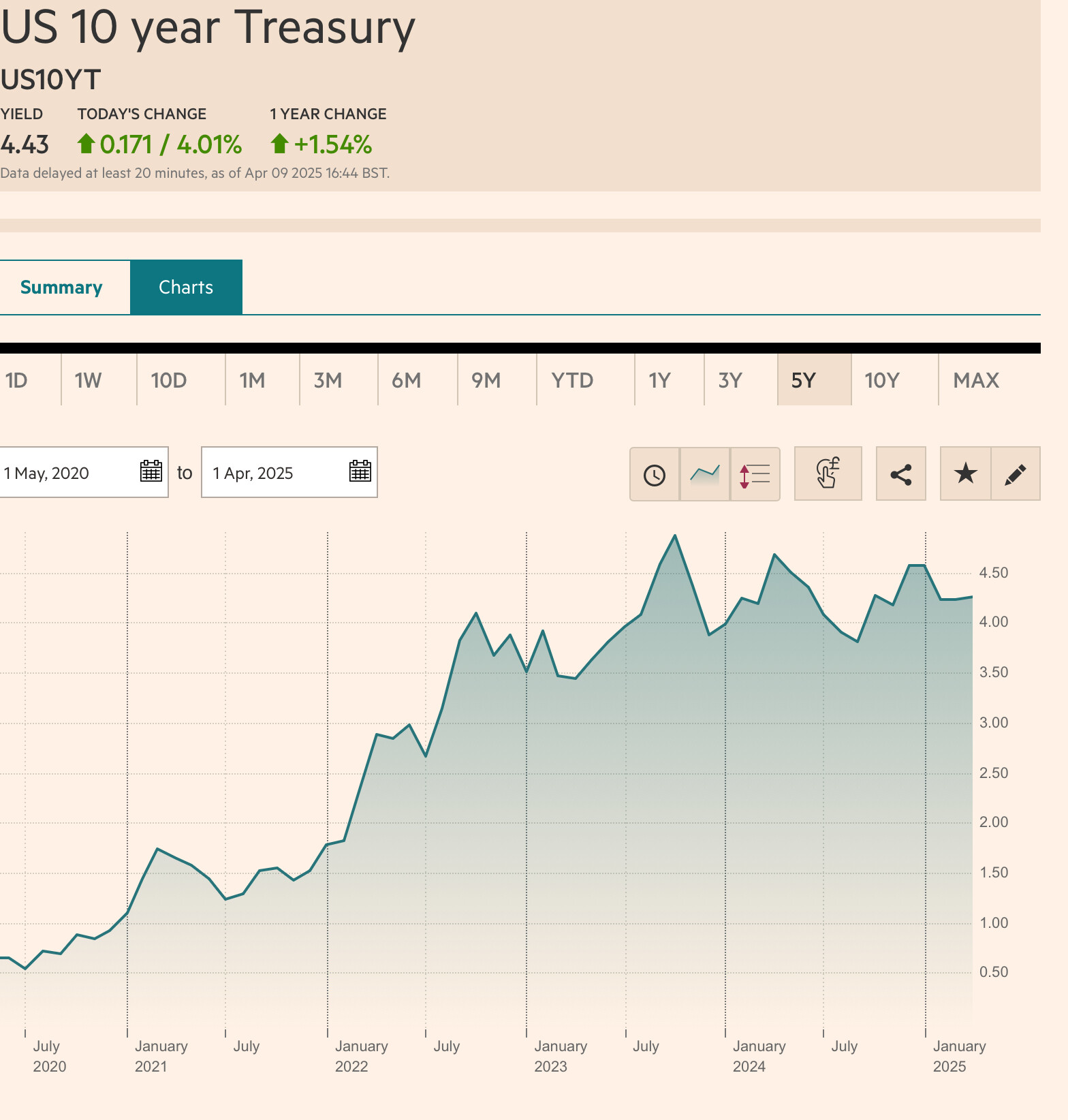
Treasury yields are now up +10% since April 3rd while the S&P 500 is down -10%.
The 10-year note yield is currently up 55 basis points in 48 HOURS.
In other words, we now have HIGHER rates with stocks pricing-in a recession.
Something broke this week.
I could buy the higher inflation expectations due to tariffs. Markets had priced two rate cuts this year. Seems harder to think of this much leeway for the Fed to cut rate if inflation spikes due to tariffs.
But to be sure, we’d better ask Ron Vara for his take on bond market moves…
I do not see panic in the yield chart. The 10 year yield was higher a few months ago. Over a five year period we are seeing much higher fluctuations due to the unwinding of helicopter Ben Bernanke’s quantitative easing.
I considered it but the limit kinda hurts for finding a place for I-bonds in my portfolio. And after getting in on last week’s 5-YR TIPS (1.7% real yield), I’m not sure why I’d settle for 1.2% real if I’m keeping either for 5-yrs. If I looked at keeping the I-bonds for longer maturity, again the yields on 10-YR TIPS or 30-YR TIPS are much more attractive than 1.2% real. And again no $10k/yr limit to restrict how much of my portfolio to hold in inflation-protected bonds.
That said, I’ve bought some the day before the deadline before so up to tomorrow 4/29 should work assuming Treasury works as it normally did before.
Yes, TIPS had the better yield. But to answer your question, they’re 5 year only not 30 year; they’re not tax deferred (unlike i-bonds); no risk to principle; and they’re easier for my less financially sophisticated relatives to obtain and understand.