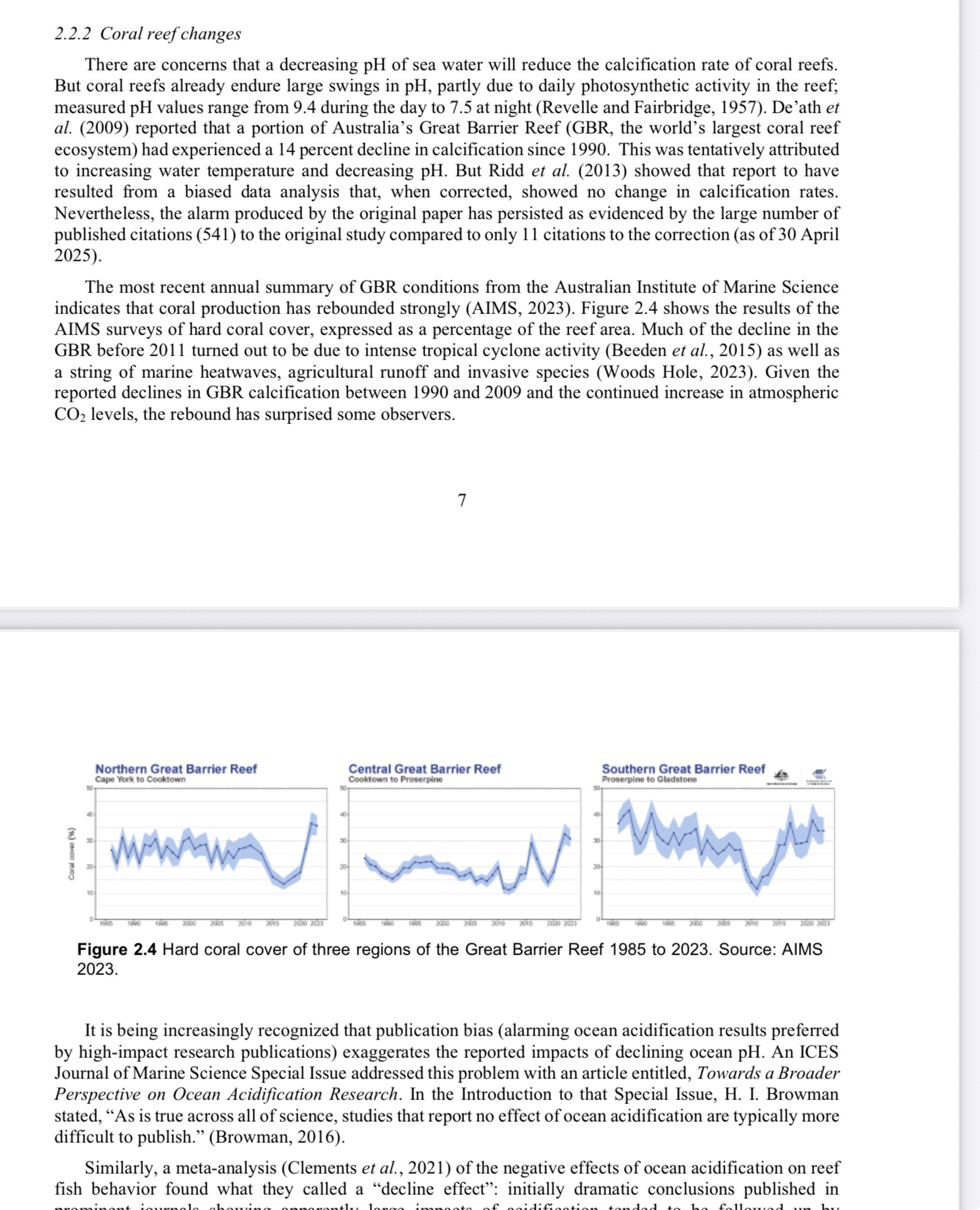
The great barrier reef is discussed in section 2.2.2 of the report. As they show, a lot of the publications are based on propaganda.
2 Likes
Found those cover charts updated for 2025: https://www.aims.gov.au/monitoring-great-barrier-reef/gbr-condition-summary-2024-25. And sure, the last drop looks bad, but there’s no obvious negative long-term trend. I’m inclined to agree – the news blows the negative events out of proportion, not positive ones. Not sure if coral cover % is all that matters, but it sounds important.
1 Like
One of the authors of the DOE report, Judith Curry, has a preliminary response to the criticism.
Before getting into specifics of the Dessler Report, a big bravo and kudos to Dessler et al., who are actually behaving like scientists with their rebuttal to the DOE report. This is exactly the kind of response and dialogue that we hoped the DOE Report would stimulate. (update: in his media interviews, Dessler is sounding pretty unhinged, at this point he risks undoing the “good” from this report).
I have skimmed the entire report (I’m a very fast reader), and paid closer attention to some of the sections related to text that I wrote. The report is organized in terms of the chapters and sections of the DOE Report, essentially providing a review of the DOE Report and suggested changes. The report is lightly edited and loosely coordinated, this is mainly a compilation (with some organization) of contributions from individual scientists. The quality of the report is very heterogeneous across the different sections. Some contributions are quite good. Others are oblique and don’t directly address what was written in the DOE Report. Other comments merely reiterate the “party line,” ignoring our criticisms of the same “party line.”
Bottom line: interesting report, laudable effort. We will be going through this report in much more detail. But in my initial assessment, the Dessler et al. report didn’t land any strong punches on the DOE Report, and I wouldn’t change any of the conclusions in the DOE Report in response. The combination of the DOE and Dessler report highlight areas of disagreement among climate scientists, and illustrates how weighting of different classes of evidence, addressing different topics, and different logical frameworks for linking evidence can lead to different conclusions. The existence of this kind of disagreement is essential information for policy makers, which hitherto has been hidden under the banner of “consensus” enforcement.
When 99.95% say Aaaa! while 0.05% say baaah!, I’d say there’s “consensus.”
Reference???
Besides the validity of a scientific claim is not established by taking a poll.
That’s true for validity, not true for consensus.
I think the point is that consensus has become about having one voice, one message, everyone being on the same page, and any disagreement is dismissed as clueless idiot nutjobs. It isnt true consensus (or, the validity comes into question) when opposing views are summarily shot down, making it appear there is consensus because it’s the only perspective that gets heard.
1 Like
The consensus is very convincing. The fact that the opposing views frequently (maybe even always) are and have for a very long time been secretly funded by the industry that opposes the consensus severely undermines the veracity of those views. It makes sense for those interests to “fund their own research,” but to do so in secret behind shell corporations and with a predetermined result is quite telling.
And I do not believe they are all summarily shot down, the reasonable ones are considered and investigated.
It is more than just consensus. The risk here is that a consensus of 4 dismisses the 5th who disagrees (even giving it due consideration), and rightly so because there is a 4-to-1 consensus. Then dismisses another alternative argument, also rightly so because it is again 4-to-1. Then they dismiss another, and another on that same basis. And now we’re at the point where each disagreement was rejected, even after being given full consideration, with a 4-to-1 consensus, but there’s actuallly a 50/50 split in agreeing with that consensus. That isnt much of a consensus, despite presenting as having significant agreement.
And that doesnt consider those who dont want to risk their reputation and employability being tarnished by disagreeing with that consensus, to the extent they never even attempt to advance their own hypothesis and findings.
I think the same happens on the other side as well. A vast majority of research is funded with expectations as to what the results will be, but that does not mean the results are manipulated. Independence comes from trusting the integrity of the researchers regardless of where the funding comes from.
1 Like
Wonder what the “consensus” says about this study?
Global sea levels have not continued to rise at the rates predicted by many scientists — and there is no evidence that climate change has contributed to any such acceleration, a new first-of-its-kind study has claimed.
The research found that the average sea level rise in 2020 was only around 1.5mm per year, or 6 inches per century, according to the paper’s authors, Dutch engineering consultant Hessel Voortman and independent researcher Rob de Vos.
This is significantly lower than the 3 to 4 mm/year often reported by climate scientists in scientific literature and the media,” Voortman told independent journalist Michael Shellenberger.
Voortman was shocked that no researcher before had performed an analysis of real-world local data.
“It is crazy that it had not been done. I started doing this research in 2021 by doing the literature review. ‘Who has done the comparison of the projections with the observations?’ And there were none,” he told Shellenberger.
The study was also unlike any of its kind in that it was carried out with no external funding, said Voortman, who has spent the last 30 years as a hydraulic engineer working with flood protection and coastal-infrastructure adaptation projects around the world.
I’m guessing that the “3 to 4 mm/year often reported by climate scientists in scientific literature and the media” most likely gets this number from international satellites, summarized here:
Curious, I searched for the word “satellite” in the study and found the following:
So it seems they used some 1960(or before)-2020 data set while ignoring satellite data which humans began collecting in 1993. I’m not qualified to decide whether this is cherry-picking or a completely valid approach. I am curious whether the numbers in the data set they used matches the satellite data starting from 1993. If it does not match, I would question the validity or applicability of their data set (i.e. one local spot on Earth is not representative of the global mean sea level rise). If it matches (which I think also suggests that there was a dip between 1960 and 1993), then the only question is whether you think the future trend will be more like 1960-today or 1993-today. Given the many causes of sea level rise, I have absolutely no reason to think it would be anything like it was 50 years ago. Of course I am also assuming that the satellite data on the NASA page is accurate, and I have not seen any reason to doubt it. It’s amazing that they’re able to measure a few millimeters change from 300 miles away.
I have a hard time comprehending them being able to accurately measure a couple millimeters change at all. Literally everything on earth can rise, sink, shift that much over the years. There is no absolute, unchanging baseline to measure from.
I tend to believe (rightly or wrongly) that they take thousands of measurments, and record the average as the official measurement. And ignore that the previous measurement remains within the margin of error for the new measurement. But I fully acknowledge I have zero understanding of the methodology used.
I asked a couple different LLMs. They provided a good summary of many different techniques (multiple global satellites, GPS buys, different altimetry techniques and calibrations, adjusting for waves, as you said averaging many measurements, systemic corrections, etc) that are combined to make such precise measurements. It’s basically magic  .
.
1 Like
Essay on climate alarmism (“the world will end in 10 years if we don’t adopt Socialism now”) as opposed to climate science.
The essay that motivates this post is a surprise admission from the New York Times that not all is well, in the form of a magazine articleby David Wallace-Wells…. When the church starts to doubt the catechism, you know the game is up.
how climate became a political and moral cause, not a scientific or technical one, and thus sowed the seeds of its demise
The “climate crisis” has been taught as gospel for 20 years. Now the average person can see their teachers have been preaching politics in the name of science. The average European and UK voter, once he or she moves on from immigration, will notice how Europe and the UK have made energy unaffordable, stopped its growth—exactly as degrowthers wish—and deindustrialized, on the altar of climate policies that do nothing to improve the climate.
3 Likes
Left wing climate scientist canceled for saying disasters are only worse because rich people build more expensive properties with nice ocean views.
In general
At the time, I, like most climate experts, thought that business-as-usual emissions would lead to around five degrees of warming by the end of this century. That assumption was never plausible. It assumed high population growth, high economic growth, and slow technological change. But fertility rates have been falling, global economic growth slowing, and the global economy decarbonizing for decades.
Nor is there good reason to think that the combination of these three trends could possibly be sustained in concert. High economic growth is strongly associated with falling fertility rates. Technological change is the primary driver of long-term economic growth. A future with low rates of technological change is not consistent with high economic growth. And a future characterized by high rates of economic growth is not consistent with high rates of population growth.
As a result, most estimates of worst-case warming by the end of the century now suggest three degrees or less. But as the consensus has shifted, the reaction among much of the climate science and advocacy community has not been to become less catastrophic. Rather, it has been simply to shift the locus of catastrophe from five to three degrees of warming.
And specifically regarding the bad data supporting worse natural disasters
Despite close to 1.5 degrees of warming over the last century, global mortality from climate and weather extremes has fallen by more than 96 percent on a per-capita basis. The world is on track this year for what is almost certainly the lowest level of climate-related mortality in recorded human history. Yes, the economic costs of climate extremes continue to rise, but this is almost entirely due to affluence, population growth, and the migration of global populations toward climate hazards: mainly cities in coastal regions and floodplains.
what determines the cost of a climate-related disaster is not just how extreme the weather is. It is also how many people and how much wealth is affected by the extreme weather event, and how vulnerable they are to that event. Over the same period that the climate has warmed by 1.5 degrees, the global population has more than quadrupled, per-capita income has increased by a factor of 10, and the scale of infrastructure, social services, and technology that protects people and wealth from climate extremes has expanded massively. These latter factors overwhelm the climate signal.
So the far more interesting question is not why my colleagues and I at the Breakthrough Institute have revised our priors about climate risk, but why so many progressive environmentalists have not.
1 Like
Bill Gates no longer into climate alarmism, focusing on improving lives for the poor. And spending his foundation money accordingly.
In the memo, Mr. Gates argued that the world should invest in efforts to lower the cost of clean energy and find ways to make manufacturing, agriculture and transportation less polluting. But the memo also sought to redirect efforts away from the campaign to reduce greenhouse gas emissions and instead focus on other ways to improve human lives and reduce suffering.
While he called climate change “a very important problem” that needs to be solved, he said that “the doomsday outlook is causing much of the climate community to focus too much on near-term emissions goals.” And that was “diverting resources from the most effective things we should be doing to improve life in a warming world,” he wrote.
2 Likes
That’s a faulty characterization. He’s still into it, he just decided to prioritize other more immediate problems, especially because of Trump’s cuts to USAID.
As usual, you provide no evidence for your assertion. The post provided this direct quote.
“the doomsday outlook is causing much of the climate community to focus too much on near-term emissions goals.” And that was “diverting resources from the most effective things we should be doing to improve life in a warming world,” he wrote.
This is not climate alarmism
As usual, you provide no evidence for your assertion. The quote you provided and the article itself does not say anything at all about Gates being either into or not into “climate alarmism.” In fact, there’s a quote from Gates himself to preempt any assumptions about what he is or is not into:
The article starts with “Bill Gates thinks climate change is a serious problem”. Maybe you have a different definition of “climate alarmism”.