The thing is, Henry Ford knew his cars were a huge step up in performance over horses.
EVs are still cars… They carry the same people at the same speed limit, in the same traffic jams, etc. Just more expensive than equivalent ICE ones.
So the case for replacing perfectly fine ICE cars by a $50k EV that may be a hassle to find public chargers for away from home still needs to be made for a lot of consumers.
I bought my Model 3 for 35K- 7.5K tax credit NEW in '19. Still drives like new and gets software updates. Great ride, sound. I do have a home charger and TSLA’s network is tough to beat.
I have not seen evidence of that for equivalent vehicles. On the contrary. Or maybe only in states which provide additional EV subsidies.
Taking the Hyundai Kona 2024 as example of identical ICE vs EV vehicles, MSRP for ICE base model is $24250 while MSRP for electric model is $32675. So even with $7500 subsidy, the purchase price of the EV is still about $1k more than that of the ICE model.
The other issue is lack of affordable options for some categories. For midsize sedans, the ubiquitous Camry and Accord MSRPs start around $28k. Hyundai Ioniq 6 MSRP starts at $38k. Model 3 MSRP starts at $42.5k. Everything else (BMW, Lucid, etc) in the midsize sedan category are way over $50k. When ordering a Model 3, the base model includes $7500 subsidy and arguable $5k 5-yr gas savings to get it to the $30k price quoted. Without subsidies, I think the $7500-higher price gap would be too steep for many buyers who won’t like a breakeven point of 8+ yrs.
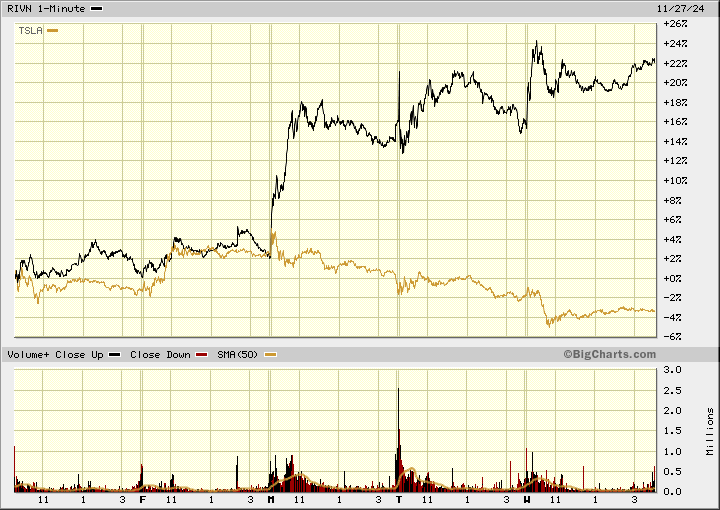
Biden is trying to flush the last of his budget down the drain before he leaves, and that includes both Ukraine and green energy loans. Pricy EV maker and large loss making company Rivian stands to get $7b.
Rivian was unable to meet production and sales targets and rapidly burned through cash. In March, the company said it would pause construction of the Georgia plant.
The loan program, created in 2007, requires a “reasonable prospect of repayment” of the loan. Under Biden, the program has announced deals totaling $33.3 billion
I forgot to check if Paul Pelosi bought some options ahead of this government move, but it sure was good for the stock.
We’re going to see some noise in October and November, and I expect that EV demand is going to drop off pretty precipitously,” General Motors CFO Paul Jacobson said during an investor event earlier this month. “We need to let it settle and understand where is that natural demand going and how do we meet that natural demand and ultimately try to lead customers to electric vehicles. That’s going to take a little bit of time.”
I’m not even sure it’s 100% natural demand considering some states have their own incentives still even if the Federal ones are gone.
I imagine at the high end (above threshold to qualify for Fed credits), we’ve already seen that natural demand level.
Natural demand could also be elastic based on gas prices vs. electricity prices. At under $3/gal here, I’m not exactly in a rush to replace my 8-yr old ICE Camry. Maybe give it another 10 years or so.
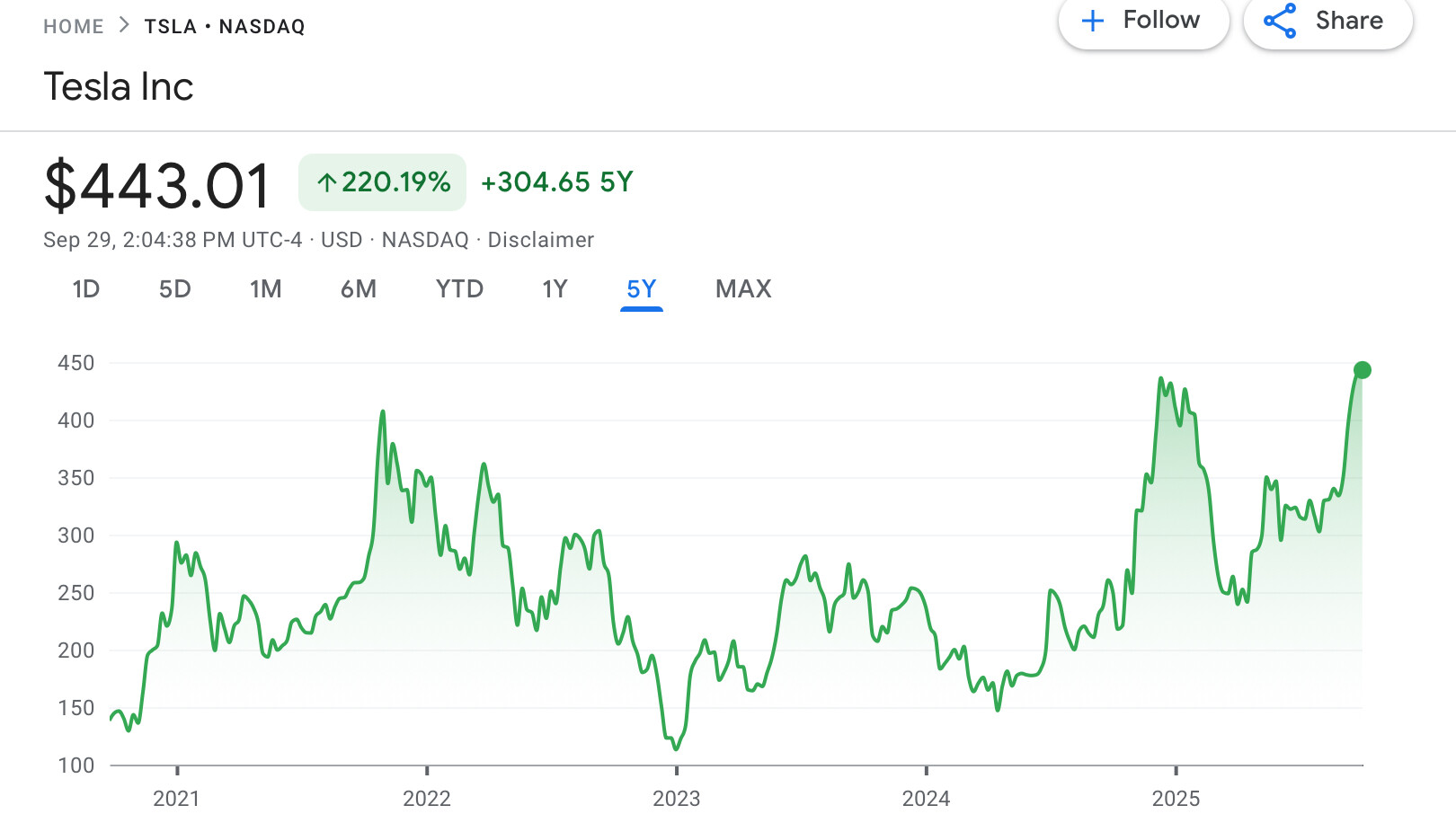
Given that climate, I don’t know how Tesla can be a buy at 200+ forward PE. It makes nvidia look like bargain bin stock.
The end of the three EVs will result in significant losses for Honda, but the brand clearly believes taking the loss on these three EVs now will be cheaper than losing cash at the dealership. The losses are truly enormous and are part of a broader spree of losses across the industry as automakers rush to kill cleaner, more efficient EVs in favor of hybrids and gasoline vehicles. Honda itself says it estimates losses of up to almost $15.8 billion. The EVs were to be developed in-house on one of Honda’s own electric vehicle platforms, which would help explain the high figur
You have a tendency to leave out important details:
I quoted verbatim, but I think there’s a typo and it meant to say “shifted away from EVs”.
The automakers made these investments because federal subsidies made EVs more reasonably priced. Now the subsidies are gone, and all-but-Chinese automakers can’t make the cars cheaply enough, so they’re cancelling plans and taking losses.
Long term, this is extremely detrimental to all kinds of research and development, because the USA has shown it can no longer be trusted to keep its word for longer than one presidential term.
You’re both saying the same thing. If they continue production, what they produce will either not sell, or sell for way under production costs. Without the government playing market-maker, there is no mass market.
How long should a government subsidy last? The problem with the EV market is that the subsidy was not intended to produce an economically superior product. It was intended to address the false Climate change religion. As the rescinding of the EPA endangerment finding shows there is no physical basis for this finding or for the subsidies.
if China is able to produce EVs at a price where they make economic sense to consumers without the subsidy then the market will decide.
This is false. The rescinding is not based in science, it’s based on feels of the current administration.
I thought the subsidy was intended to do both. Its purpose was to speed up AND make cheaper the development and production of EVs and related technologies, which also helps address climate change.
I think it did quite well in terms of making them cheaper. Solar energy with battery storage is now cheaper than fossil fuels even without subsidies. Solar and battery farms are still being built everywhere (even in Illinois), and will continue to be built, they’re printing money.
The market can only decide if it is allowed to decide. Canada allowed it, but the US is blocking Chinese carmakers from selling their EVs here. It would likely decimate the domestic auto industry. BYD is like $8K for a decent EV, even with 100% tariff it’s a steal.
I’m not so sure. China has massively subsidized their R&D on EVs for years. They started slowing down customer subsidies in 2022, and further reduced subsidies to industry last year since the EV industry is mature enough to not need as much fiscal stimulus.
So, the US taking a similar approach now is not that surprising. If an industry has reached enough maturity, it should not need much subsidies. Case in point, the breakeven point of 2-4 years between EVs and ICE vehicles is pretty reasonable now. So all in all, the need to continue a fiscal stimulus we cannot afford seems much less to me now. I’d rather see investment in EV charging infrastructure since it’s still way behind where it should be in many parts of the country. That’d seem more sensible investment to me manufacturer subsidies.