For me, the main part is that their self-serving is very rarely directly transferring money from unwilling taxpayers to themselves. Book deals or speaking engagement: basically milking their popularity like any other celebrity but you’re also free not to pay them. Insider trading: murkier since I’m indirectly harmed financially by the uneven playing field. But at least there are attempts at preventing it like the Stop Insider Trading Act (H.R. 7008).
But suing your own administration for Billions is a level of brazen kleptocracy that should make other politicians blush. Kinda like the difference between someone noticing the cashier make a mistake in their favor and not saying anything vs. Suharto-level thievery.
If I had to guess, he will never actually get the money. He will make a big production about how he could have won the case, but out of the kindness of his heart he won’t accept the payout.
As far as other politicians doing the same ( again on a smaller denomination ), the Senate shoe horned a similar thing in the bill to end the government shutdown.
Tax refunds possibly for interest penalties during COVID from prior years.
A federal court ruled last November that the COVID-19 public health emergency from Jan. 20, 2020, through May 11, 2023, fell under this provision. Add in 60 days, and the new tax deadline for tax year 2019, 2020, 2021 and 2022 filings would have been July 10, 2023.
Without taxes due, the IRS likely also had no right to levy penalties and interests during that window, tax lawyers said. So, if you were charged penalties or fees, you may be owed a refund, they said.
Millions of taxpayers could be eligible, but if people don’t file claims before July 10, 2026, they lose out on the potential for a refund or abatement," said Jon Wasser, partner at Fox Rothschild who focuses on tax issues.
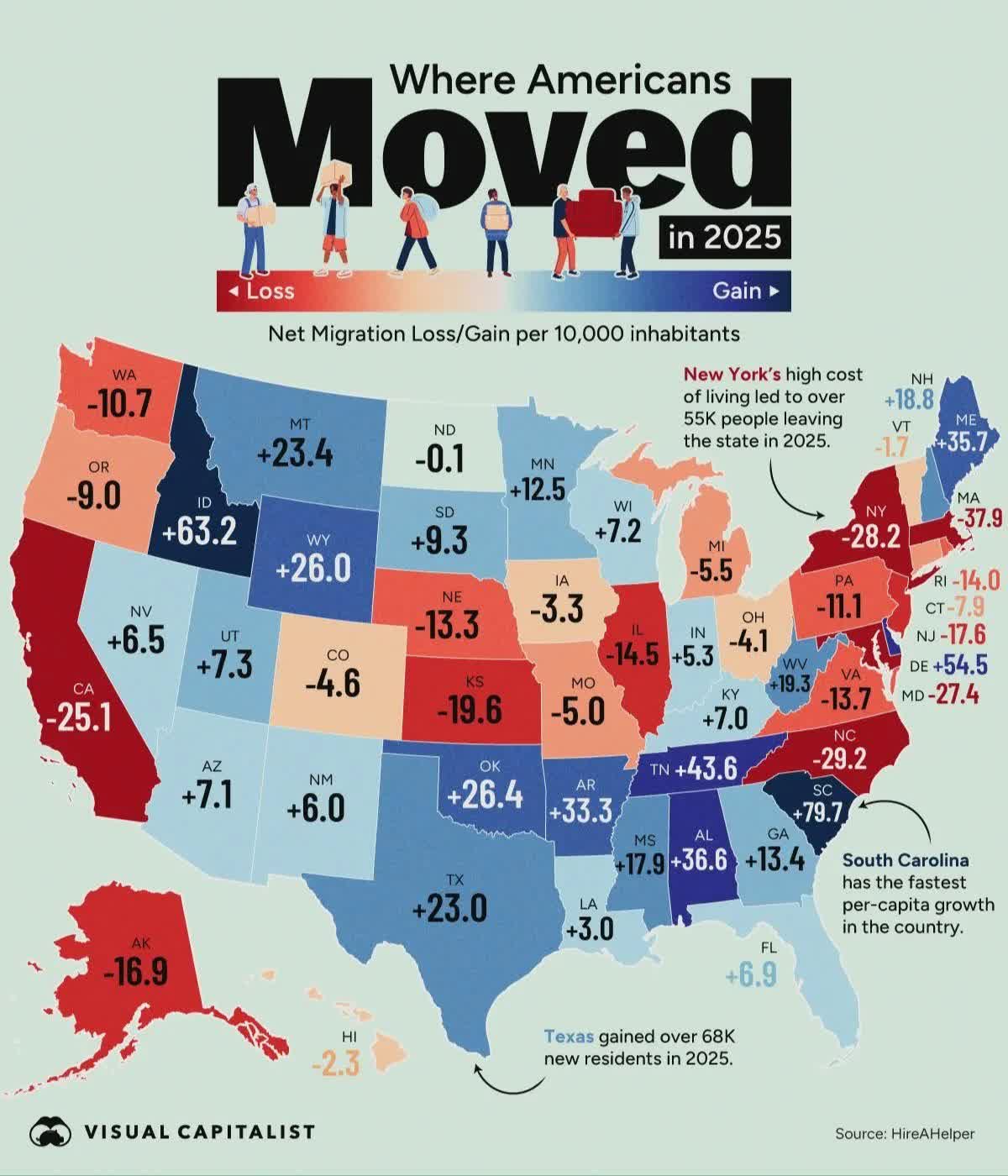
I agree state tax is probably a factor but I really don’t think this is the whole picture. If you check the tax foundation data on state tax competitiveness index Alaska is 3rd best, North Carolina 12th best and both saw large outflow of population. Vice versa Minnesota is ranked 44th and yet saw pretty substantial influx of population.
Doing a correlation analysis, Pearson correlation coefficient between individual state tax competitiveness rank and population inflow, is -0.41 which means a moderate negative correlation (low rank correlated with population influx). Corporate state tax competitiveness shows weaker (-0.28) correlation. Same -0.25 to -0.29 correlation for other taxes. Overall tax competitiveness is a bit stronger at -0.5 but that still suggests to me that other factors (maybe housing, job growth, climate or demographics - older vs younger population movements) are also playing a significant part. No doubt though that affordability factors in state taxation so not surprising that statistically speaking, lower taxation states would attract population more than higher taxation states.
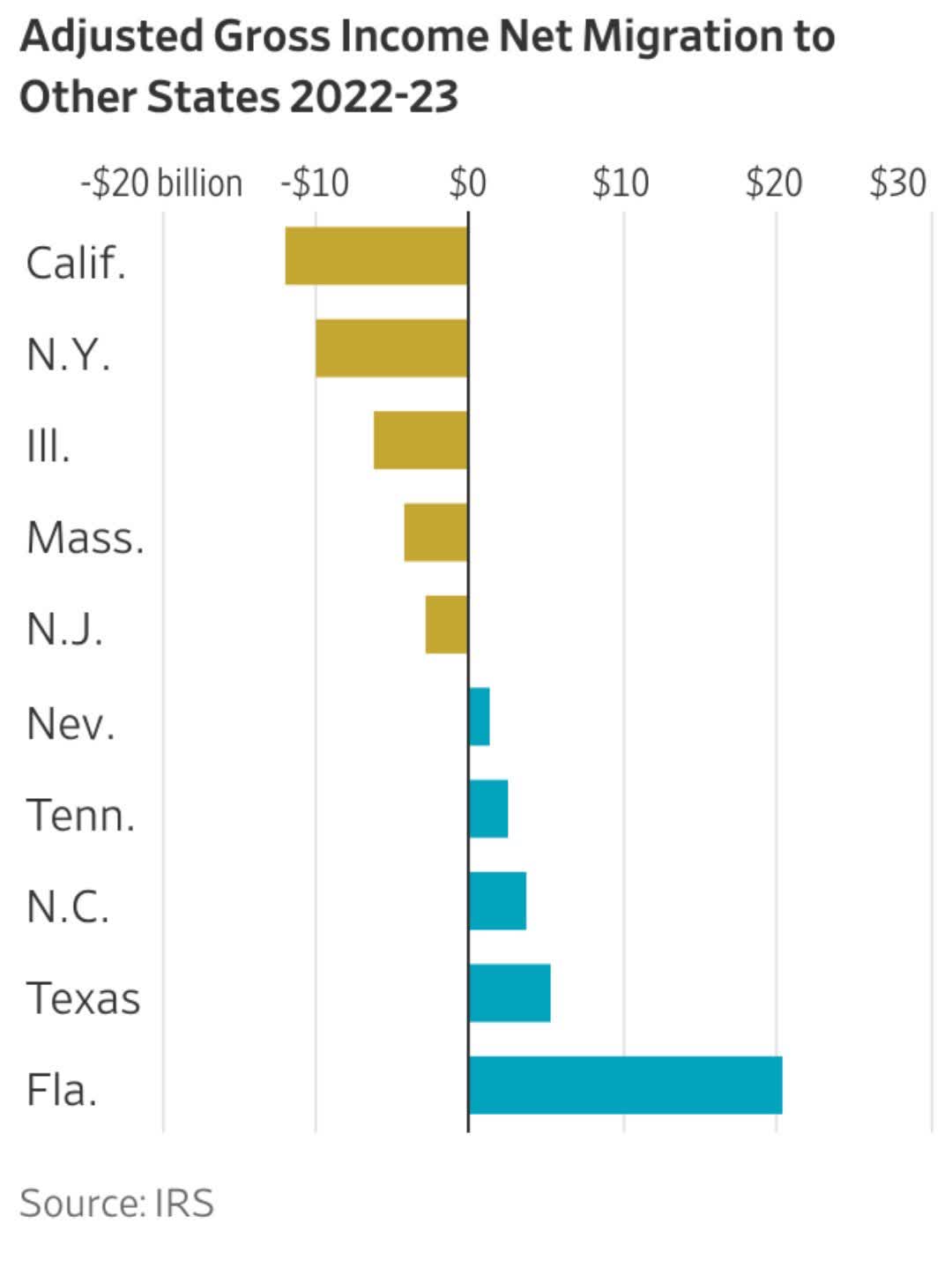
Isn’t that chart practically meaningless? Would a chart showing the impact of that lost income on the states’ budgets or overall economy be more useful?
For example, a billionaire jet setter might only spend a tiny part of their income where they live, while spending the rest on their lavish travels or simply reinvesting, so their move out of CA or NY certainly reduces those states’ revenue, but a move into TX or FL, where there’s no state income tax, adds little financial benefit to the new home state. Much less than this chart might imply.
And it’s not only the rich who migrate – those who can’t afford to live in places like CA and NY also move to cheaper places. A low income person who collects more state benefits than they contribute could be a net benefit for the former home and a net loss for the new one.
I read this graph a bit differently. I thought that graph from the WSJ did not show gains/losses in state revenues, just the difference in combined AGI of population flows (total AGI of all filers moving into the state - total AGI of all filers moving out of the state). It’s a bit more granular than just population in/out-flows but barely. A more meaningful picture would be the median AGI of filers moving in vs of those moving out or a per capita AGI gain/loss.
Neither of which would equate easily to state revenue gains or losses for states with no income tax like FL, TX, NV, or TN. It may result in extra real estate taxes or sales tax but you’d probably be better served directly checking tax revenues of each state directly to figure that out.
But certainly for CA, NY, IL, MA, and NJ, total net AGI losses lead to losses of state tax revenues. Although a bit of a drop in the bucket. Even assuming the $12B of net AGI lost in CA was from filers in the top CA bracket of 13.3% (worst case scenario for tax revenues), that’d be about $1.5B of lost income tax revenues which, on total tax revenues of $282B in 2022, is just about -0.5%.
The socialist wing of the Democratic Party, which sometimes include Gavin Newsom, is talking up their billionaire wealth tax (he was against it for CA but for it for the whole US). Only it turns out it starts at $50M, is an annual tax not a one-time tax, audits 30% of everyone covered, counts your irrevocable trusts and other money you gave away, and isn’t indexed for inflation.
I guess we’ll just have to see what loophole Ro Khanna writes for his family and his $100M+ fortune.
In 2024, Khanna’s financial disclosures clocked in at 333 pages of non-text-searchable tables, listing over 3,000 individual assets owned by him, his wife, and his children, with each asset having ticked one of 13 available boxes corresponding to an asset valuation range. Put together, those assets are worth anywhere from $103 million to more than $340 million
This should be a non-starter for any tax bill. Every phase in/phase out tax item should come with an inflation adjustment otherwise from year 2, it’s going to hit taxpayers the original bill did not intend to hit.
The threshold looks fine to me at either $50M, $100M or whatever level the country decides is acceptable. If indexed on inflation, it doesn’t sound like it’d leave those affected destitute…
In principle, it sounds like a federal property tax. But earmarking it for education, child care, etc. sounds a bit like mental accounting to me. Whatever it’d be earmarked for, the general budget for that spending could then be shrunk by the same amount leaving politicians free to direct more general revenues elsewhere. Maybe the revenues could be funneled to the Social Security/Medicaid trust funds since they are a bit more insulated from general revenues…
P.S.: all this assuming it’s constitutional to start with and that a practical implementation and compliance scheme can be established. Valuation of illiquid assets would be a huge headache.
Oh no doubt the lack of inflation adjustment would be an intentional attempt to increase its tax base over the years… but that level of kindergarden deception should not be tolerated.
I know it is much less palatable when a new tax isn’t associated with a new benefit, but where are country currently is, a tax like this should be focused on properly funding current expenses vs. adding new expenses. Be it debt payments, social security deficit, etc. The problem with adding a new program to spend the new revenue is that typically the new program grows faster than the revenue and we end up with just another source of debt spending some number of years down the road.