You are right. I doubt that the four states mentioned are the only ones that will not coordinate their taxes to the federal. As I mentioned, with California’s major budget problems. I very much doubt they will change their tax code. I think that, in the end, all the Democrat run states will not coordinate.
1 Like
I think that’s an issue shared by a lot of Democratic states so I agree it’s likely they won’t be in a rush to change their tax codes and reduce their state income tax revenues, at least not until their voters pressure them to do so.
They’re rather stupid and ill-thought-out deductions anyways. According to the whole concept of progressive taxation, overtime should be taxed at a HIGHER rate, not exempted, since the employee is getting paid MORE for the same hour of time. An employee earning overtime wages is 50% wealthier than the employee earning straight time wages, despite working the same hour and [potentially] doing the same work.
I wouldnt expect states to play along with policy that is pure vote-buying. Especially in states where the powers-that-be have already bought all the votes they need.
I agree that no tax on tips is stupid and ill-thought-out, but I’m not convinced no tax on overtime is entirely stupid. The actual details, per IRS:
It only applies to one third of overtime pay, $12.5K max, capped AGI. Basically a <= $2750 gift to a small number of hard- many-hours-working low- to upper-middle class workers. It’s not exactly regressive, especially because
an employer wouldn’t be paying overtime unless they really needed to. Probably. I don’t know, in my line of work everyone is salaried except interns, and as an intern I only managed to get overtime once.
Until employers start redefining their compensation structures to account for that lack of taxation of overtime. The $300k MAGI limit does not rule out many workers actually. In terms of households, this corresponds to about 94th percentile. So if more employers tried to lower labor costs by shifting part of the compensation from regular time to overtime, MAGI limit wouldn’t be a big limiter. And loss of $2750 tax revenue applied to this wide a potential tax base could be very significant.
Same with tips, especially if these changes are made permanent down the line. Pressure could build to save labor costs by shifting to more tips and overtime and thus increase loss of tax revenues.
Right - it only taxes the overtime amount, ie, the extra that person is receiving over the person working next to him doing the same work for the same pay rate. It’s taxing the person making more less. At a 20% tax rate, the person being paid more is now paying an effective 13% rate compared to the person being paid less who is being taxed at 20%.
What happening to demanding that everyone “pay their fair share”?
CA is about to learn why wealth taxes don’t work, and lose extra income even without passing it due to the legal uncertainty they’re generating pitching this new tax.
Billionaires including Peter Thiel, the tech venture capitalist, and Larry Page, a co-founder of Google, are considering cutting or reducing their ties to California by the end of the year because of a proposed ballot measure that could tax the state’s wealthiest residents, according to five people familiar with their thinking.
The moves are being driven by a potential California ballot measure from the health care union, Service Employees International Union-United Healthcare Workers West, the people said. The proposal calls for California residents worth more than $1 billion to be taxed the equivalent of 5 percent of their assets… Those with $20 billion in assets who resided in the state on that date would face a one-time tax of $1 billion…
If the measure gains enough signatures to reach the state ballot in November and wins approval, it will retroactively apply to anyone who lived in California as of Jan. 1, 2026.
2 Likes
What would be the actual loss of revenues for the state if that passed anyway though?
If the wealth of these billionaires was not taxed before, all that’s gonna be lost is the taxes on their income which we know they structure to avoid paying hardly any. And the few who remains in CA may make up for that loss.
Also I have no idea how a one-time tax would be handled. Would it mean that the 95% remaining would never be subject to wealth tax again? Would it be taxed otherwise when/if they realize gains? Sounds like a can of worms and surely something that’s gonna get legally challenged before it comes into effect.
Anyway, it’s kinda funny to me though to see these billionaires reaching for the exits when threatened to pay one-time 5% of wealth they’ll never be practically able to spend. Imagine paying your fair share of taxes instead of borrowing against it and paying an effective tax rate lower than your rank employees… inconceivable! 
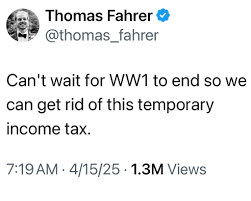
There’d have to be some kind of framework for not taxing wealth that has already been taxed. Even our income tax does not tax realized gains more than once (although estate tax effectively may). That’s why I cannot picture how a truly one-time tax would be implemented.
We have other examples of one-time tax events. Like tax on assets repatriated to the US (like the MRT of the TJCA of 2017). Once subjected to MRT, these assets are not subjected to tax again but it’s easier to isolate these foreign assets from their origin unlike what would happen for a one-time tax of US-held assets. Maybe some sort of separate basis would have to be tracked establishing the level of wealth previously taxed the next time CA votes to do another one-time tax of wealth…  Sounds like a mess for unrealized gains for sure.
The big consulting company that employed the Trump IRS leaker got a bunch of their contracts canceled today. BAH stock fell -10%, losing roughly $1B in market value.
The U.S. Department of the Treasury today announced that Secretary of the Treasury Scott Bessent canceled all 31 separate contracts with consulting firm Booz Allen Hamilton. The contracts total $4.8 million in annual spending and $21 million in total obligations.
The cancelation follows a data breach by Charles Edward Littlejohn, an employee of the firm. Between 2018 and 2020, Littlejohn stole and leaked confidential tax returns and return information, affecting approximately 406,000 taxpayers. Littlejohn pled guilty to felony charges for disclosing confidential tax information without authorization.
1 Like
How does $5 million/year in revenue translate into $1 billion market cap? Buying opportunity?
Edit: Whoops, I misread the article and thought it said the government cancelled all their contracts. Which admittedly didn’t sound right either.
Or fearing the cancellation of other contracts with the federal government?
"The firm’s latest quarterly filing with the SEC, for the period ending Dec. 31, states that major risks to the firm include “any issue that compromises our relationships with the U.S. government or damages our professional reputation, including negative publicity concerning government contractors in general or us in particular.”
3 Likes
I love a company with booze in the name.
Plus Trump wanted to sue someone for this leak, and BAH is only worth $10B so instead of suing them for $10B, he’s suing the IRS.
I wonder if his own DOJ will settle the case and pay him off with our money, like what the Biden DOJ did with the $1m payoffs to their anti-Trump investigators who got caught hating Trump while working on the federal case against him. Only 10,000x Yuuuger.
$10B suit on the IRS reaches a new low in attempting to weaponize the government to enrich yourself. Ordering the DOJ to settle the case would be on par with self-serving track record so I’m expecting prompt compliance.
I shouldn’t be surprised at how brazenly he doesn’t give a xxxx about grabbing money from taxpayer pockets while giving lip service on affordability. Yet I still am. Who cares about adding $10B to the deficit, let me line my pockets first. Clearly makes clear where the priorities are: me and my family >>>> country.
2 Likes
While I agree, the same is true for nearly every politician seeing sudden net worth explosion once joining Congress. I could probably count on 1 hand the number of politicians I feel are country >> themselves.
1 Like
Sure, but their grift is measured in Millions, mostly probably from speaking engagements, book deals, and insider trading, not Billions from writing themselves a check from the Treasury. These are different levels of >>>>>>
1 Like